Nov
4
Wednesday, November 4, 2026 | 12:00 PM CDT
Darla P. Henderson, PhD
Nov
18
Wednesday, November 18, 2026 | 12:00 PM CDT
Kenneth Walsh, PhD
Dec
16
Established in 1987, the Society for Redox Biology and Medicine (SfRBM) provides solutions to global health challenges by advancing research and applications of redox biology.

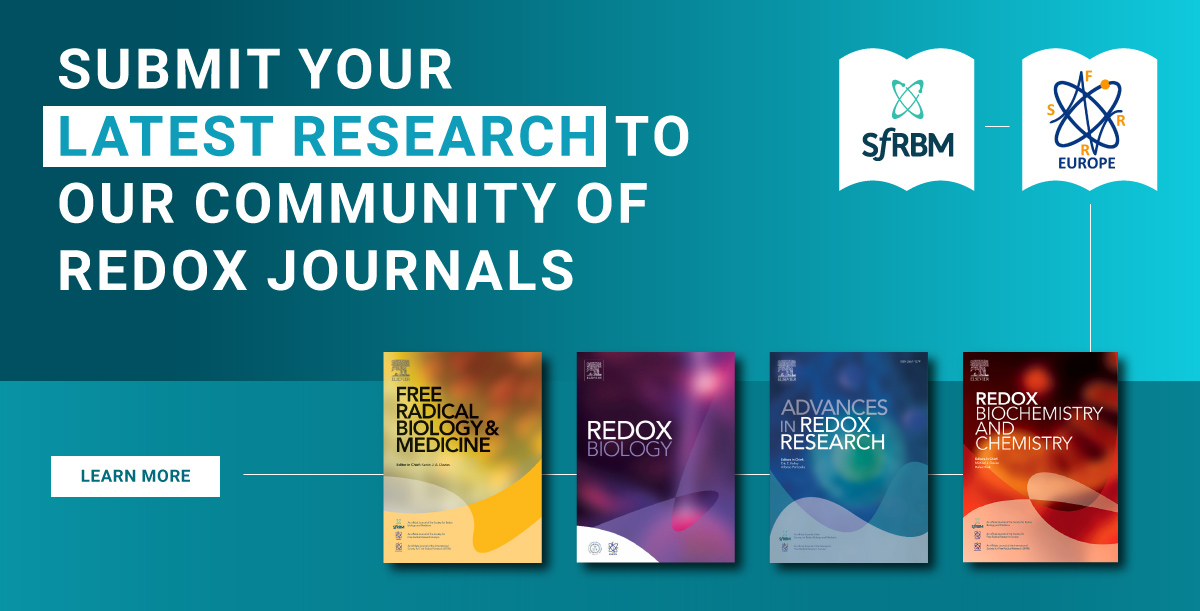
Publication date: December 2026 Source: Redox Biology, Volume 98 Author(s): Mauro Siragusa, Luke S. Dunaway, Eckhard Lammert, Ingrid Fleming, Brant E. Isakson, Miriam M. Cortese-Krott

Publication date: January 2027 Source: Free Radical Biology and Medicine, Volume 258 Author(s): Weirui Chen, Xiaoxin Ye, Anbang Ren, Anan Xu, Rong Li

Publication date: December 2026 Source: Advances in Redox Research, Volume 21 Author(s): Mojtaba Kordrostami, Abolfazl Mazandarani, Ali Ebadi

Publication date: December 2026 Source: Redox Biochemistry and Chemistry, Volume 18 Author(s): Abdolkarim Talebi Taheri, Michael Aschner, Omid Reza Tamtaji
August 24, 2026
It is with great sadness that we share news of the passing of Ronald P. Mason, PhD, on August 18, 2026, at the age of 82. Ron was a long-time SfRBM member, an SfRBM Fellow, and a recipient of our Lifetime Achievement Award. He was a pioneer in the biological detection of free radicals and mentored more than 50 scientists over his career.
April 29, 2026
We are delighted to announce the recipients of the 2026 SfRBM Travel Awards for the South American Redox Symposium taking place May 16–19, 2026, in Águas de Lindóia, Brazil. Please join us in congratulating these outstanding trainees on their achievements!
April 29, 2026
Dr. Ruma Banerjee, Vincent Massey Legacy Professor of Biological Chemistry at the University of Michigan, was recently elected to the National Academy of Sciences.
P.O. Box 1488
Warrenville, IL
info@sfrbm.org


® Copyright 2026 Society for Redox Biology and Medicine